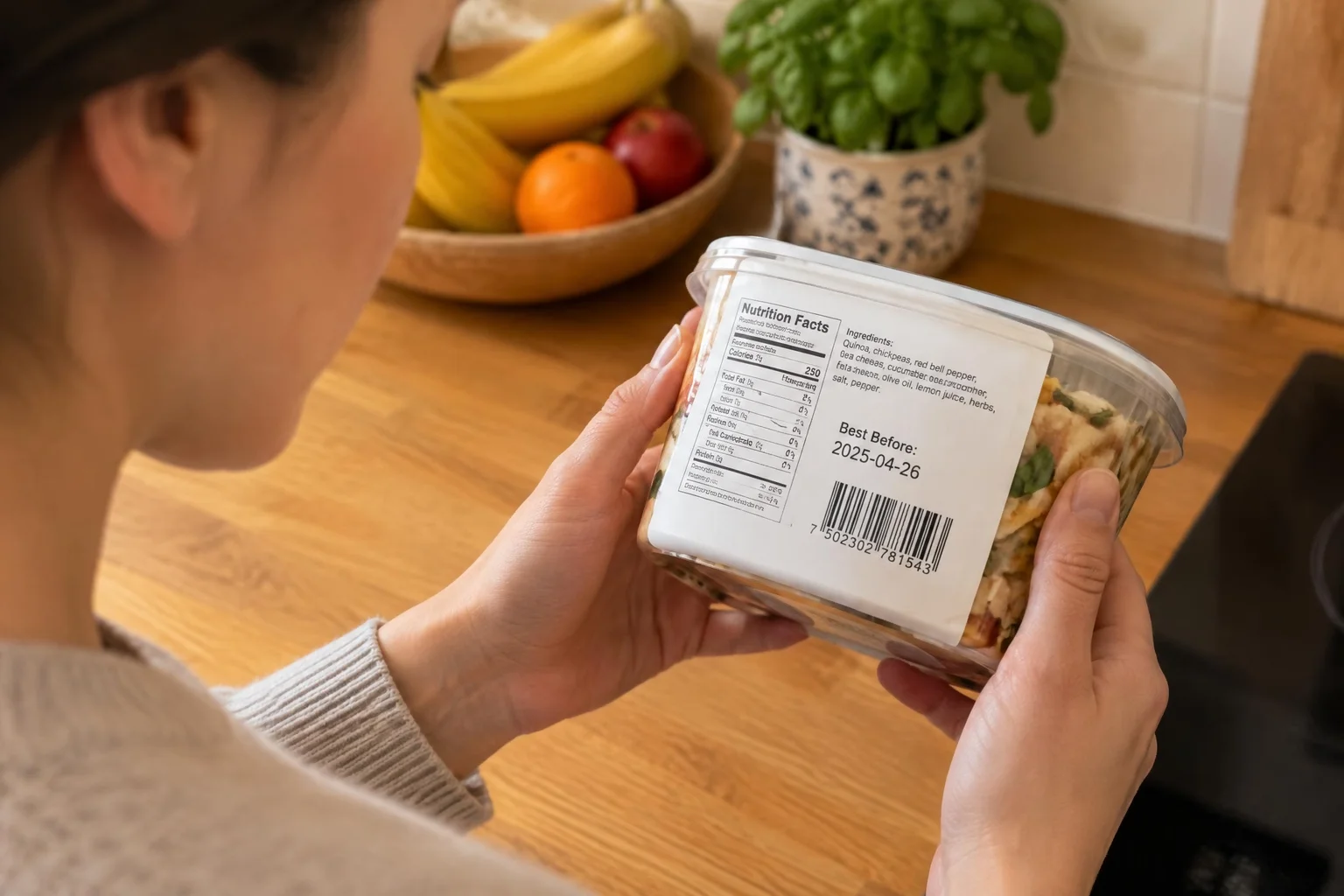
Best before means quality, not a safety deadline
A best-before date describes the freshness, taste, nutritional value and other claimed qualities of properly stored, unopened food. It is about quality, not a guarantee of safety, either before or after the date. [1][2]
Passing a best-before date does not automatically make food unsafe. Equally, being before the date does not make badly stored food safe. Once a package has been opened, its shelf life may change; follow the product’s storage instructions. [1][2]
- Read the words beside the date: “best before / meilleur avant” is different from “expiration”.
- Check the storage instructions before using a date to plan a meal.
- Record when you open a package rather than treating its best-before date as an opened-food deadline.
Expiration dates: discard after the date
Expiration dates apply to specific foods with strict nutritional or compositional requirements, including infant formula, meal replacements and nutritional supplements. After the expiration date has passed, discard the product; do not eat or donate it. [1]
Do not substitute a best-before rule for an expiration date. CFIA says food past its expiration date should not be bought, sold or eaten. If the label is unclear, ask the manufacturer rather than guessing. [1]
Read packaged-on and other labels in context
A packaged-on date on qualifying retail-packaged food needs accompanying shelf-life information, on the label or a nearby poster. The packaged-on date alone does not tell you how long to keep the food. [1]
Other labels such as “sell by”, “prepared on” and “freeze by” may be voluntary. CFIA notes that “use by” can replace “best before” on prepackaged fresh yeast; do not assume every date phrase means the same thing. [1]
- Ask the retailer where the shelf-life information is shown.
- Read the whole label, including any direction to refrigerate after opening.
- If a product’s identity or storage history is uncertain, do not use a date as permission to eat it.
Reference for these steps and questions: [1]
Storage matters more than a taste test
Smell or taste cannot establish food safety. Harmful microorganisms may be present even when food does not appear spoiled. Never taste food to decide whether it is safe. [1][2][3]
Visible spoilage is a reason not to use food, but the absence of spoilage is not proof that it is safe. Consider how the food was stored, how long it has been opened and the food-specific instructions. When in doubt, throw it out. [1][2][3]
- Was the food stored as directed throughout?
- Is it still unopened, or do you know when it was opened?
- Have you checked official food recalls and followed any instructions for this product?
Use dates to plan, not to override safety
Try a small household check: sort unopened products by date, identify which have best-before labels and which have expiration labels, and put foods you can safely use into your next meals. This is a planning exercise, not a determination that any particular item is safe. [1][2]
For donations, a recipient’s acceptance rules still matter. A best-before date that has passed is not automatic approval to donate; an expiration date that has passed means discard, not donation. [1][2]
Sources
Numbered links beside the text point to these official sources. Practical examples and questions are planning suggestions, not new safety rules. Linking does not imply endorsement.
More food guides & local next steps
Explore the food location list & map →Limited local coverage, not a Canada-wide inventory. A listing does not confirm current availability or donation acceptance. Contact the service before travelling.
General education, not individualized medical or legal advice. This guide cannot determine whether a particular food is safe. See our disclaimer.