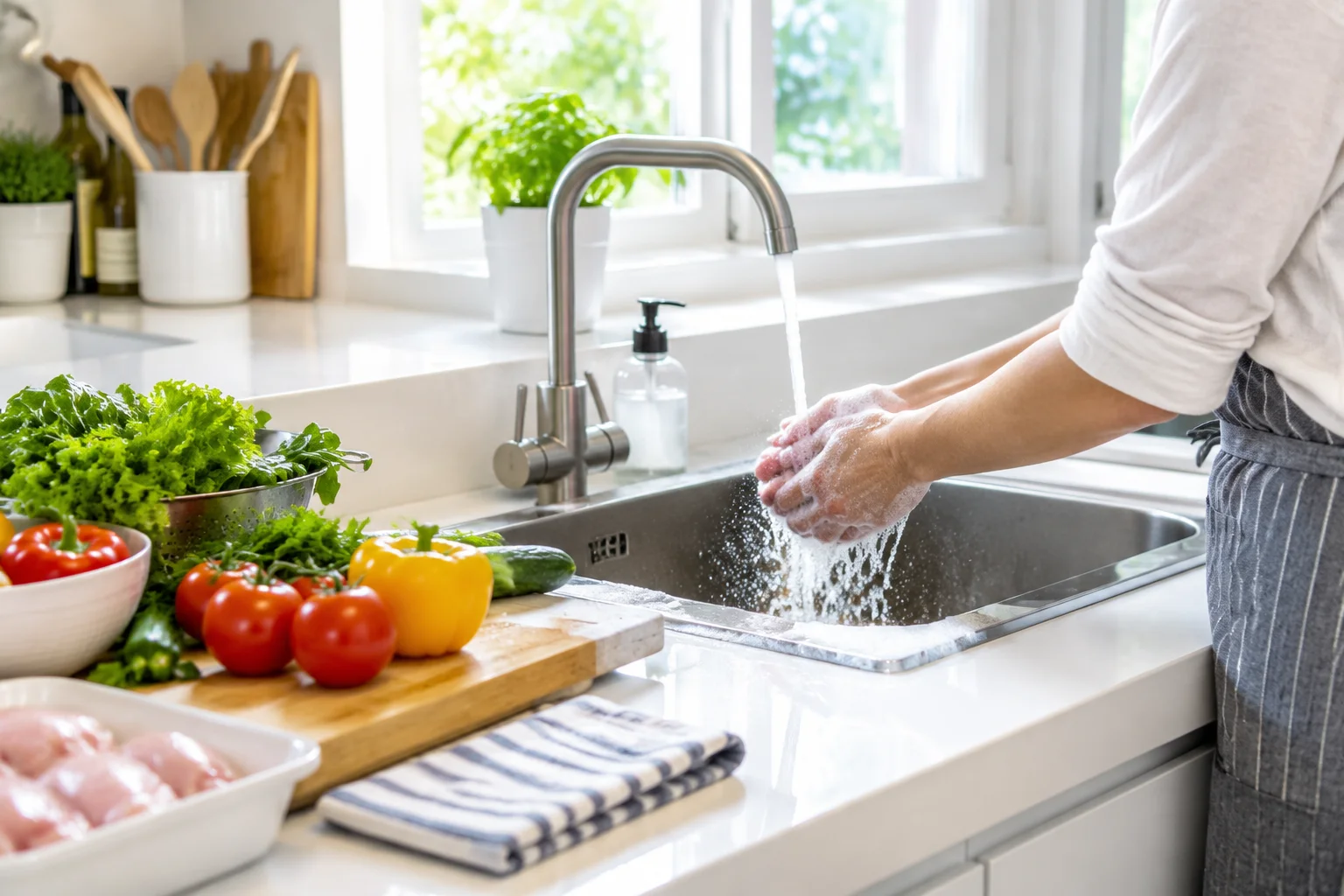
Start with clean hands and separate preparation
Wash hands with warm, soapy water for at least 20 seconds, especially before and after handling raw meat, poultry, fish or seafood. Wash utensils and plates used for raw food before using them again. [3]
Keep raw foods and their juices away from ready-to-eat foods. Use a separate cutting board for produce and another for raw meat, poultry, fish and seafood. [3]
- Wash fruit and vegetables under potable running water; do not use soap.
- Clean and sanitize work surfaces and equipment, following the sanitizer’s directions.
- Store raw meat and seafood in sealed containers on the bottom refrigerator shelf so juices do not drip onto other food.
Reference for these steps and questions: [3]
Keep cold food cold
Set your refrigerator to 4°C or lower and your freezer to -18°C or lower. Keep space for cold air to circulate rather than overstocking the refrigerator. [3]
Buy cold and frozen foods near the end of a shopping trip. Refrigerate or freeze raw meat, poultry, fish and seafood as soon as possible, or within two hours. Follow the label’s storage directions. [3]
- Keep raw products separate from other foods during shopping and storage.
- Do not treat a best-before date as evidence that food was kept cold.
- Plan ahead for cold storage before buying more perishable food than you can handle.
Reference for these steps and questions: [3]
Cook with a thermometer, not a colour test
Different foods have different safe internal cooking temperatures. Use Health Canada’s food-specific instructions, not one temperature for every raw food. Check the thickest part with a clean digital food thermometer, avoiding bones. [3]
Colour is not a reliable safety test. Keep cooked food away from uncooked food; hot foods should be held at or above 60°C. [3]
Cool and date leftovers promptly
Cooked food left out at room temperature for more than two hours must be discarded. Refrigerate leftovers promptly in shallow containers. Very hot items can first cool until steaming stops; this is not permission to leave food on the counter for hours. [4]
Health Canada’s specific leftover guideline says to eat refrigerated leftovers within 2 to 3 days, or freeze them for later use. Label containers with the contents and date. Use clean containers and keep different types of leftovers separate. [4]
- Leave lids off or wrap loosely while leftovers cool to refrigerator temperature.
- Use the 2 to 3 day leftover guideline here, not a longer generic storage estimate.
- If you do not know how long cooked food sat out, do not assume that reheating will make it safe.
Reference for these steps and questions: [4]
Thaw safely and reheat only the portion you need
Thaw frozen leftovers in the refrigerator or microwave, not on the counter. Consume or cook promptly after thawing; microwave-defrosted leftovers should be used immediately and not refrozen. [4]
Reheat leftovers to an internal temperature of 74°C, measured with a digital food thermometer. Bring gravies, soups and sauces to a rolling boil and stir. Discard uneaten leftovers after reheating. [4]
- Use microwave-safe containers and loosen the lid for steam to escape.
- Stir midway through microwave reheating so heat is distributed evenly.
- Set aside the portion to reheat rather than repeatedly warming the whole container.
Reference for these steps and questions: [4]
When uncertain, stop and check
Smell or taste cannot tell you whether food is unsafe; do not taste it to test its safety. When in doubt, throw it out. Check official food recalls and advisories and follow the instructions for the affected product. [3][4]
Children under five, older adults, pregnant people and people with compromised immune systems can be at higher risk of serious foodborne illness. Use the official guidance for higher-risk groups. This guide is general education, not medical advice or an assessment of your food. [3][4]
- Do you know its storage history?
- Have you measured the relevant temperature rather than guessed?
- Does the label or an official advisory give a more specific instruction?
Sources
Numbered links beside the text point to these official sources. Practical examples and questions are planning suggestions, not new safety rules. Linking does not imply endorsement.
More food guides & local next steps
Explore the food location list & map →Limited local coverage, not a Canada-wide inventory. A listing does not confirm current availability or donation acceptance. Contact the service before travelling.
General education, not individualized medical or legal advice. This guide cannot determine whether a particular food is safe. See our disclaimer.