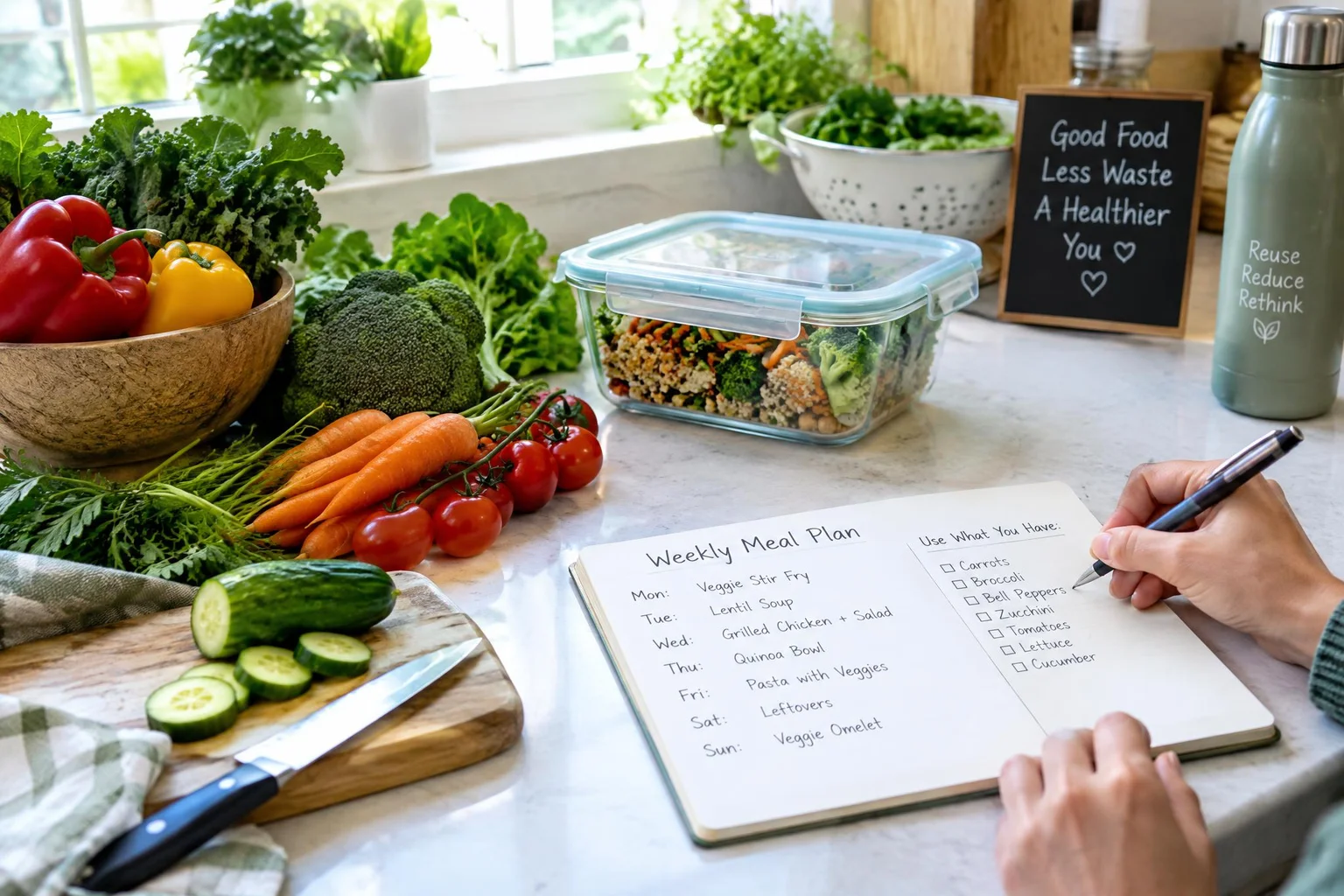
Take a small inventory before shopping
Canada’s Food Guide recommends using the food you already have and buying what you need and will use. As a practical way to apply that advice, look through your fridge, freezer and cupboard before planning your next shop. [8][1][4]
Write a short inventory: what is available, which fresh ingredients need using first, and which safely stored leftovers already have a date. This is a suggested household routine, not a food-safety assessment. [8][1][4]
- Choose a visible “use first” space without changing required storage conditions.
- Check dates and labels; do not combine expiration dates with best-before dates.
- If you cannot establish a food’s storage history, do not put it into a meal just to avoid waste.
Plan a few meals with overlapping ingredients
Plan for a couple of days or a whole week—whichever fits your schedule. Think about how many people will eat, the time available to cook, and meals and snacks you actually expect to have at home. [8][4]
Choose recipes with overlapping ingredients and use fresh ingredients first. For example, you might plan two meals that both use the same fresh vegetables; the point is to give the ingredients a realistic use, not to buy extra for a perfect plan. [8][4]
- Allow for a busy day with a simpler meal.
- Use fresh, frozen, canned or dried ingredients as appropriate to the plan.
- Only plan extra cooked portions if you can cool, store and use them safely.
Turn the plan into a shopping list
Use a shared shopping list and subtract ingredients already in your inventory. Canada’s Food Guide suggests keeping a list where everyone can add to it, and planning purchases around what you need and will use. [8][3]
A suggested check before a bulk purchase or offer: will the household use it, and is there suitable storage? A larger pack is not helpful if the surplus will sit unused or cannot be kept safely. [8][3]
- List the missing ingredients for planned meals and snacks.
- Check how many people will actually be eating before deciding quantities.
- Review the list against the food at home before leaving for the shop.
Give leftovers a date and a next meal
Refrigerate leftovers promptly in shallow containers, label them with their contents and date, and eat refrigerated leftovers within 2 to 3 days or freeze them for later use. Cooked food left at room temperature for more than two hours must be discarded. [4]
Thaw frozen leftovers in the refrigerator or microwave. Reheat leftovers to 74°C using a digital food thermometer, and discard uneaten leftovers after reheating. These safety limits come before any waste-reduction goal. [4]
- Plan a specific next meal for a safely stored leftover portion.
- Reheat only the portion needed, using microwave-safe containers if applicable.
- Do not use smell or taste as a test of safety.
Reference for these steps and questions: [4]
Prevent first; recovery is not a cure for food insecurity
ECCC’s food recovery hierarchy prioritizes prevention: prevent waste, recover suitable surplus, recycle what can be recycled, then dispose as the least-preferred option. Applied at home, planning to use food comes before routinely buying too much and hoping to donate it. [7]
Recovery of surplus food for people can preserve its value, but ECCC explicitly does not present it as a solution to food insecurity. Donation also depends on safe food and a recipient that agrees to accept it; follow the Ontario-specific donation guide rather than assuming any surplus can be dropped off. [7]
Review one recurring waste problem
Try an optional end-of-week reflection: which ingredient was repeatedly left unused, and could the next plan use a smaller quantity or a recipe that shares it? These prompts are a planning aid, not a promise of savings. [8][4]
Keep any notes privately at home. You do not need an account, tracking app or personal-data form to make a short meal plan. [8][4]
- What did our schedule change after we shopped?
- Could a smaller shop or a simpler meal have helped?
- Did we plan safe storage and a next use for the extra portions?
Sources
Numbered links beside the text point to these official sources. Practical examples and questions are planning suggestions, not new safety rules. Linking does not imply endorsement.
More food guides & local next steps
Explore the food location list & map →Limited local coverage, not a Canada-wide inventory. A listing does not confirm current availability or donation acceptance. Contact the service before travelling.
General education, not individualized medical or legal advice. This guide cannot determine whether a particular food is safe. See our disclaimer.